
Shopping Cart




AssaultRunnerRunning on air: intense training without a motor
AssaultRunner: the curved treadmill for training without artificial limits
Forget everything you know about conventional motorised treadmills. The AssaultRunner series has fundamentally changed stationary cardio training. As curved treadmills, they work entirely without a motor. Here no belt drags you along – you are the only drive. Every km/h on the display is your own performance.
On this page you will find out how a curved treadmill works, what advantages it has over a classic treadmill, how to train on it and which of the three models, Classic, Pro and Elite, suits you. You will find videos on the AssaultRunner further down.

The AssaultRunner at a glance
- Curved treadmill without a motor: driven purely by your own muscle power
- Running surface made of heavy-duty rubber slats in an ergonomic curve
- Speed without limits: you run as fast as you like
- You control speed through your position on the running surface, with no buttons
- Natural cushioning for a joint-friendly running feel
- No power consumption, only the display needs small batteries
- Handle and wheels for easy moving, low-maintenance
- Three models: Classic, Pro and Elite
Contents
What exactly is a curved treadmill? Physics and biomechanics
A conventional treadmill is driven by an electric motor. The motor power determines the top speed, and all you do is try to keep up with the belt. That is passive running.
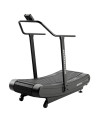
A curved treadmill such as the AssaultRunner, by contrast, works mechanically through your own muscle power. The running surface consists of heavy-duty rubber slats arranged in a precise, ergonomic curve.
- Drive through gravity and friction: as soon as you place your foot in front of your centre of gravity, you push the slats down and back. The further forward you land on the curve, the faster the belt accelerates
- Intuitive speed control: if you want to hold your pace, you run in the middle. If you want to slow down, you let yourself slide back a little. There are no buttons and no waiting for a motor; the response is immediate
- Natural ergonomics: the shape of the AssaultRunner automatically guides you towards a better running style. You land more naturally on the forefoot or midfoot. This reduces the typical impact of heel striking on flat belts and is kinder to knees and hips
 In competition use |  Runners on curved treadmills |  Training indoors |
Why the AssaultRunner takes your training to a new level
The AssaultRunner allows training without restriction. Because it runs without a motor, it has no top speed. You can run as fast as you like. That makes the machine ideal for HIIT and fast sprints.
| Benefit | What it means for you |
|---|---|
| Speed without limits | No top speed: sprints and intervals at your own maximum |
| Simple operation | Step on and run, without pushing the speed up and waiting for the motor |
| Safety | You control the pace yourself at all times. If you run slower, the belt slows down too. There is no preset pace that you cannot keep up with |
| Natural running feel | The curve gives a pleasant running sensation and natural cushioning |
| Training benefits | Full focus on running, ideal for HIIT and sprints |
| Environmentally friendly | No motor, no power consumption |
| Low-maintenance | Little technology and no annoying motor noise |
Running without limits: speed, technique and joints
At the start you do not have to laboriously push the speed up and wait until it is reached. This is ideal especially at high speed, because you can concentrate fully on running.
You regulate the pace through your position: if you move forward on the treadmill towards the curve, the speed increases. If you want to slow down, you let yourself drop back a little into the rear part of the running surface. No settings at all are needed on the treadmill.

The curve provides natural cushioning. Running on the AssaultRunner is therefore particularly easy on the joints. The running surface consists of rubber slats with a grippy texture.

Workouts for the AssaultRunner
If you have never run on a curved treadmill before, start slowly and get used to the curve. Increase pace and duration step by step. Two to three sessions a week are enough to start with.
| Workout | Structure | Goal |
|---|---|---|
| Getting started | 10 to 15 minutes of easy running, finding your position on the curve | Getting used to the curved belt |
| Sprint intervals | 8 to 10 rounds of 20 seconds fast, then 60 to 90 seconds of walking | Speed and fitness |
| Pyramid | Rising and falling intervals, for example 30, 60, 90, 60, 30 seconds at a brisk pace with walking breaks | Endurance and pace changes |
| Base endurance | 20 to 40 minutes at a steady, easy pace | Endurance and recovery |
The figures are guideline values for healthy people: adjust duration and intensity to your level and get medical advice first if you have any pre-existing conditions. For more structure at the start, see the article Getting started with fitness: the perfect training plan for beginners. For short sessions, the article Training when you're short on time: efficient workouts with Assault equipment is worth a look.
Setting up, moving, care
Because the AssaultRunner has no motor, it uses no electricity either. That is kind to the environment and saves energy. Only the display needs small batteries. This independence lets you place the treadmill freely in the room. With a handle and wheels, the AssaultRunner is very easy to move.
The AssaultRunner has no complex technology and is therefore extremely low-maintenance. You also have no annoying motor noise during training. Tips on care are given in the expert guide to equipment care and safety. You will find suitable parts in the Runner spare parts. You will find ideas for your home gym in the article Setting up a home gym: equipment and kit for maximum performance.
The AssaultRunner family: the right model for every setting
There are different versions, from the ambitious home user to the high-end CrossFit® studio:
 AssaultRunner Classic The ideal entry into motorless training at home | 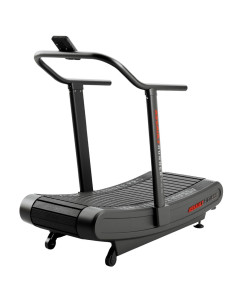 AssaultRunner Pro The proven workhorse for ambitious athletes and studios |  AssaultRunner Elite The flagship of the series for commercial use |
AssaultRunner Classic
The newest model and the perfect choice for your home gym. The AssaultRunner Classic brings Assault technology into a compact design optimised for private users. It offers the identical, intense running feel of the professional machines but dispenses with the massive dimensions of the commercial models. The ideal entry into motorless training at home.
AssaultRunner Pro
The proven workhorse for ambitious athletes and professional gyms. The AssaultRunner Pro is designed for maximum stability during intense sprints and offers a console with built-in programmes that delivers precise data for your performance tracking.
AssaultRunner Elite
The flagship of the series for commercial use. The AssaultRunner Elite is developed for hard continuous use in CrossFit® boxes and performance centres. It offers maximum durability, additional storage for water bottles and smartphones and an extremely solid construction for absolute smoothness at top speeds.
The AssaultRunner comparison puts all models side by side.
Videos of the AssaultRunner
AssaultRunner video (watch on YouTube)
Another AssaultRunner video (watch on YouTube)
Which AssaultRunner is right for you?
| Model | Key feature | Particularly suitable for |
|---|---|---|
| AssaultRunner Classic | Compact design optimised for private users with the running feel of the professional machines | Home gym and entry into motorless training |
| AssaultRunner Pro | Maximum stability in sprints, console with built-in programmes and performance tracking | Ambitious athletes and gyms |
| AssaultRunner Elite | Maximum durability, storage for water bottles and smartphones, extremely solid construction | CrossFit® boxes and performance centres |
To complement your running, the AssaultBikes for cardio with arms and legs and the AssaultRower for rowing are a good fit. If you want to clarify your training goal, the article Building muscle vs. losing fat will help.
Conclusion: your run, your rules. The AssaultRunner is more than a piece of fitness equipment, it is an investment in your health. It forces you to be honest: you have earned every km/h on the display yourself. Experience the most natural running feel possible in an enclosed space.
FAQ: frequently asked questions about the AssaultRunner
What is a curved treadmill?
A curved treadmill without a motor. The running surface of rubber slats is arranged in an ergonomic curve and is moved by your muscle power alone.
Does the AssaultRunner need electricity?
No. It has no motor and uses no electricity. Only the display needs small batteries.
How do I control the speed?
Through your position on the running surface. If you run further forward on the curve, the belt gets faster; if you drop back, it gets slower. There are no buttons.
Is there a top speed?
No. Because no motor limits the speed, you can run as fast as you like. That makes the AssaultRunner ideal for HIIT and sprints.
Is running on the AssaultRunner easy on the joints?
The curve provides natural cushioning, and the shape guides you to land on the forefoot or midfoot. This reduces the typical impact of heel striking. If you have any pre-existing conditions, discuss training with your doctor or therapist first.
Can I fail to keep up with the pace and get injured?
You control the pace yourself the whole time. As soon as you run slower, the belt slows down too. There is no preset pace that you cannot keep up with.
Does the AssaultRunner need a lot of maintenance?
No. There is little technology built in, so it is extremely low-maintenance. You will find suitable parts in the Runner spare parts.
Can I move the AssaultRunner easily?
Yes. A handle and wheels make moving it easy.
Which AssaultRunner is right for my home gym?
The AssaultRunner Classic is compact and optimised for private users. It offers the same intense running feel as the professional machines, without their massive dimensions.
What distinguishes the Pro and the Elite?
The Pro is designed for maximum stability in sprints and has a console with built-in programmes. The Elite is built for hard continuous use in a commercial setting, with additional storage for water bottles and smartphones and an extremely solid construction.
How often should I train on the AssaultRunner?
Two to three sessions a week are enough to start with. Get used to the curve slowly and increase pace and duration step by step.
Ready for your AssaultRunner?